

The 1951-52 Parkhurst Set: The Birth of the Modern Hockey Card
If you've been collecting vintage hockey for any length of time, you already know it all starts here. The 1951-52 Parkhurst set is ground zero for the modern hockey card - the release that brought the hobby back to life after more than a decade of silence, and the one that gave the world the very first cards of Gordie Howe and Maurice Richard.
The History of the Set
After production was halted during World War II, no major manufacturer had released a hockey card set since the 1940-41 O-Pee-Chee issue. Parkhurst Products, a Toronto-based company, changed that in 1951 with a 105-card set covering the six teams that made up the NHL at the time: the Montreal Canadiens, Boston Bruins, Chicago Black Hawks, Detroit Red Wings, Toronto Maple Leafs, and New York Rangers.
The cards are small - 1¾" x 2½", smaller than the standard size we know today - printed on heavy card stock with crude, somewhat washed-out color photography by modern standards. The player's name, team, and a line of 1950-51 season stats appear at the bottom of the card. Uniquely in Parkhurst's history, the backs are completely blank, with no player information at all.
Numbering follows the teams: Canadiens (1-18), Bruins (19-35), Black Hawks (36-51 and 53), Red Wings (54-69), Maple Leafs (70-88), and Rangers (89-105). Card #52 breaks the pattern entirely: instead of a player portrait, it shows the now-legendary photo of Bill Barilko flying through the air after scoring the Stanley Cup-winning goal in 1951 - his final goal before he disappeared in a plane crash that same year.
Because no major set had been produced in over a decade, nearly every card in the 1951-52 Parkhurst set is a rookie card, with a handful of exceptions — Sid Abel, Max Bentley, Turk Broda, and Milt Schmidt — who were already established stars before the set's release. This set also marked the start of Parkhurst's run as the primary hockey card manufacturer, a position it held until Topps entered the market in 1954.
The Most Important Cards
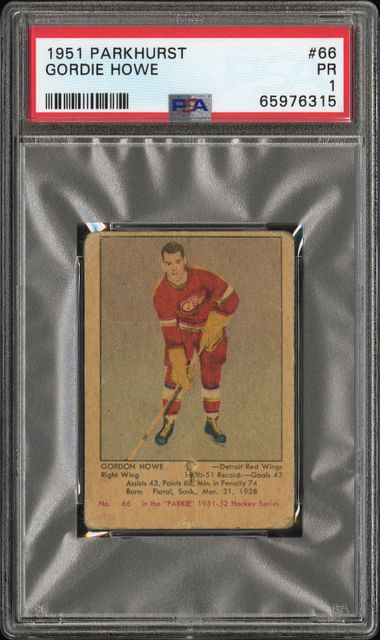
66 Gordie Howe (Rookie) — The undisputed centerpiece of the set, and arguably of the entire vintage hockey hobby. This is the only recognized rookie card of Mr. Hockey, who had actually debuted in 1946 but didn't appear on cardboard until this release. Demand for high-grade copies far exceeds supply — it's the anchor piece for any serious Original Six collection.
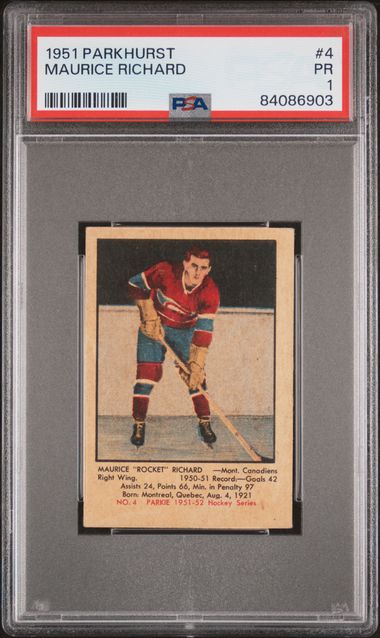
4 Maurice Richard (Rookie) — The Rocket's first card, and one of the most iconic pieces in Quebec and Canadian hockey history. Nearly as coveted as the Howe, and especially in demand from a Quebec-based seller — local demand for this card is steady and strong.
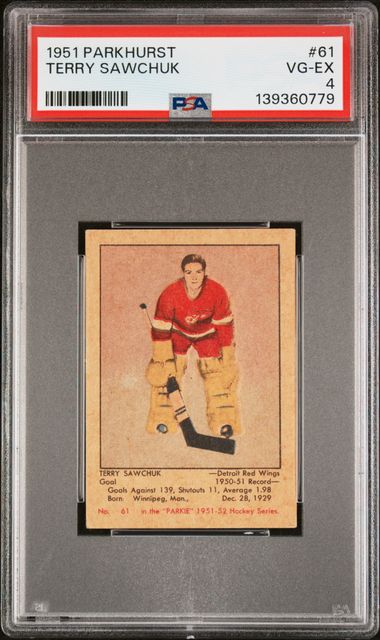
#61 Terry Sawchuk (Rookie) — The first card of one of the greatest goaltenders in NHL history, a three-time Stanley Cup and Vezina Trophy winner. This rounds out the set's "big three" rookies alongside Howe and Richard.
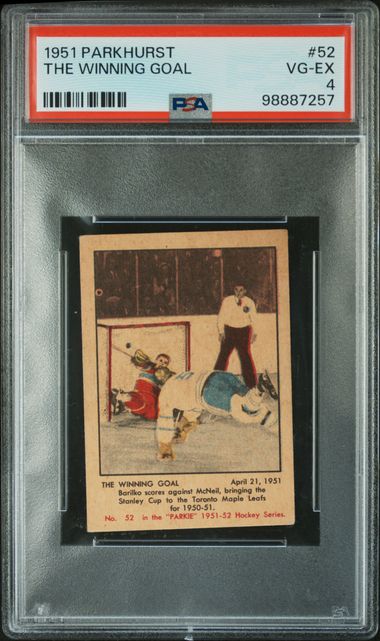
52 The Winning Goal (Bill Barilko) — The only card in the set that isn't a standard player portrait. Its historical and symbolic weight — the goal, followed by Barilko's disappearance — makes it a standalone chase card, sought after even by collectors who don't actively collect the Maple Leafs.
Worth noting: the set's other Hall of Fame rookies form the backbone of any complete-set pursuit — Doug Harvey (#10), Bernie Geoffrion (#14), Red Kelly (#55), Alex Delvecchio (#63), and Turk Broda (#75, already established at the time).
Counterfeit warning — hobby experts consistently flag counterfeits of Howe, Richard, and Sawchuk given their value. Any raw purchase of these three cards deserves serious scrutiny before buying, or should go straight to grading.
Estimated Market Quantities
The 1951-52 Parkhurst set is inherently limited - a single print run, never reissued - but true scarcity depends heavily on the specific card and its condition.
Based on the most recent PSA population data reviewed, the #66 Howe has roughly 650-700 total copies submitted to PSA across all grades, with a sharp drop-off at the higher end of the grading scale. Historically, only around fifty copies have reached EX-MT 6, and the number drops further above that threshold - anything NM-MT 8 or better is considered a museum-grade piece within the hobby.
The Richard (#4) and Sawchuk (#61) follow a similar population profile - several hundred total copies submitted to PSA, heavily weighted toward the lower-to-mid grades (Good through VG-EX, or 2 to 4). High-grade examples (NM 7 and above) are scarce across the entire set, a direct result of the fragile card stock and the total lack of protective handling when these cards were originally distributed and played with.
These numbers shift continuously as more raw copies surface from old family collections and get submitted for grading - so treat them as directional benchmarks, not fixed totals. For any serious pre-purchase or consignment valuation, always check the current PSA population report at the time of the transaction.
Why This Matters for NordSlab
The 1951-52 Parkhurst set remains one of the most liquid and recognizable vintage releases in the entire hobby - a foundational asset for anyone building a serious pre-war/Original Six hockey holding. If you've got raw or graded copies from this set, or want to talk through a valuation, reach out.


